Let’s be honest. Most traders will tell you that if you store your yoga wear in a cool, dry place, it stays “new” forever. They’re lying. Or, more likely, they just don’t understand the chemistry of what they’re selling.
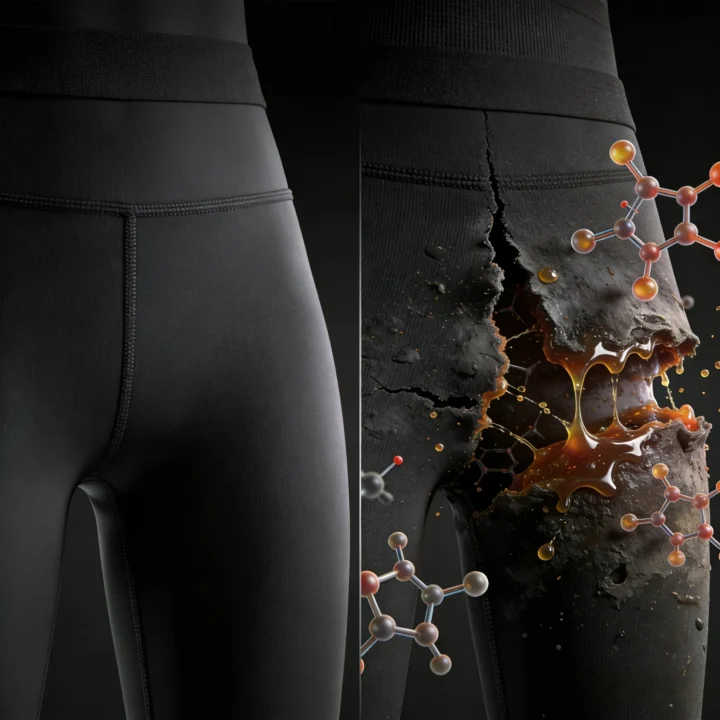
If you’re a boutique owner or a brand founder, you’ve probably experienced this: You open a box of restocks that’s been in the warehouse for six months, and the leggings feel… off . They’re a bit sticky, they have a weird industrial scent, and they don’t “snap” the way the first batch did.
You haven’t been cheated by the factory. You’ve been cheated by chemical decay.
1. The “Silicone Trap”: Softness with an Expiration Date
Everyone wants that “buttery soft” hand-feel. To get it cheap, factories drown the fabric in hydrophilic silicone softeners. It’s a shortcut. Instead of weaving a high-density fabric, they use a lower-grade knit and “mask” it with chemicals.
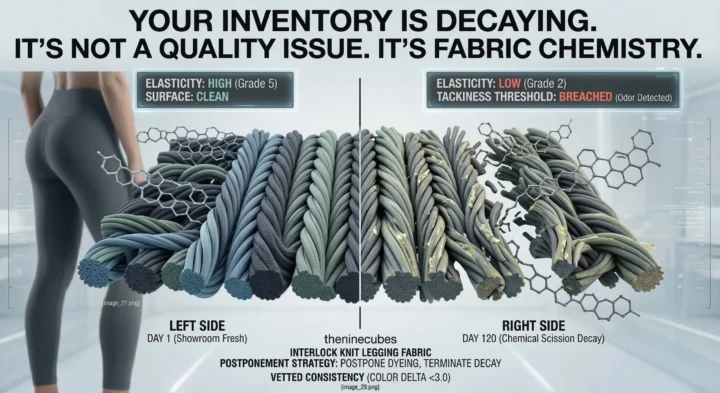
Here’s the problem: Those silicones aren’t permanent. By the time your container clears the port and sits in a warehouse for 90 days, those molecular chains are already breaking down (it’s called Oxidative Scission ).
The Result: That “buttery” feel turns into a “tacky” residue.
The Risk: If your inventory turnover is slow—say 100+ days—you aren’t delivering a premium product anymore. You’re delivering a chemically degrading one.
2. Spandex Fatigue: The Cost of “Static Stress”
Spandex is a living polymer. It hates being compressed. When you pack 50 pairs of leggings into a tight shipping carton and leave them there for months, the fibers undergo Static Stress Relaxation. I’ve seen high-end labels lose 20% of their core customer base because their restocks felt “stretched out” compared to the originals. It wasn’t a pattern issue; it was Inventory Fatigue. The fabric literally forgot its shape because it spent too long under pressure in a hot shipping container.
3. My “Greige-Buffer” Strategy: Trading for the 2026 Market
As a trader, my job isn’t just to find you the lowest FOB. It’s to protect your capital. This is why I’ve moved away from the “Stockpile Finished Goods” model.
For my serious clients, we use a Greige-Fabric Commitment. We weave the fabric but leave it uncolored and unfinished.
Why? Greige fabric is chemically stable. It doesn’t oxidize. It doesn’t smell.
The Logic: We trigger the dyeing and finishing only 21 days before delivery. This means when the goods hit your door, the “chemical clock” has just started. Your customers get the “freshest” possible version of the product, with the maximum elasticity and the cleanest scent. You aren’t buying old stock; you’re buying a fresh batch engineered for today’s sentiment.
4. The Bottom Line: Stop Buying “FOB,” Start Buying “Freshness”
In 2026, the cost of unsold inventory is the #1 brand killer. If your supply chain partner doesn’t understand the shelf-life of a 230GSM interlock, they are a liability to your balance sheet.
At theninecubes , we don’t hide behind chemical additives. We use Mechanical Finishing (physical polishing and air-washing) to get that soft hand-feel. It’s harder to do, and it costs a few cents more, but the quality stays locked in for 18 months, not 18 days.
Are you buying a product that rots, or are you buying an asset that lasts?